Guide to Writing a Cover Letter for Job Application
Written communication remains an important part of hiring. Understanding how to write a cover letter for job application is therefore a valuable career skill.
Professional opportunities are often competitive, with multiple applicants meeting similar technical requirements.
In such situations, employers may look beyond qualifications alone to identify candidates who demonstrate motivation, self-awareness, and communication abilities.
Knowing how to write a cover letter that resonates can help make a stronger case for an applicant, especially in a crowded field.
What Is a Cover Letter for Job Application?
A cover letter for job application is a professional document, usually limited to one page, that may accompany other application documents such as a CV or resume when applying for a role. Its purpose is to introduce you to the employer and explain why your background, including your skills and experience, makes you a strong candidate for the position.
A cover letter for job application matters because it:
- Demonstrates written communication and storytelling ability.
- Showcases logical thinking and analytical skills.
- Provides context that may not fit naturally within a CV.
- Highlights enthusiasm and interest in the opportunity.
- Allows employers to better understand your professional motivations.
In a nutshell, when used effectively, a cover letter for job application can help create a more complete picture of your qualifications and suitability.
A cover letter for job application is just one of several kinds of cover letters. Some other kinds of cover letters include:
Prospecting Cover Letter
A prospecting cover letter is sent to an organisation that has not publicly advertised a vacancy.
Job seekers use this approach when they are interested in working for a particular company and want to introduce themselves.
The letter should express interest in the organisation, highlight relevant qualifications, and ask about current or future opportunities that may be a good fit.
Networking Cover Letter
A networking cover letter is used when contacting someone within your professional network, such as a former colleague, mentor, industry contact, or professional acquaintance.
Although it should remain professional, the tone is often more conversational than a traditional application letter. Its purpose is to reconnect, discuss career goals, and seek guidance or information regarding potential opportunities.
Referral Cover Letter
A referral cover letter is written when someone has recommended you for a position.
The referral may come from a current employee, manager, client, mentor, or another professional contact associated with the company.
Mentioning the referral early in the letter can strengthen credibility and increase the likelihood that your application receives attention.
Structure of a Professional Cover Letter
A professional letter should follow a clear structure so that the reader can quickly identify who you are, why you are writing, and what you can offer.
Typical sections include:
- Header: Your contact information and relevant application details.
- Greeting or salutation: A professional opening addressed to the appropriate person.
- Opening paragraph: Your introduction, the position you are seeking, and your reason for applying.
- Middle paragraph(s): Your relevant skills, experience, achievements, and evidence of suitability.
- Closing paragraph: A concise statement of interest and an invitation to continue the conversation.
- Sign-off: A professional closing followed by your full name.
Tips to Make Your Cover Letter for Job Application Stand Out
Research the Company
Before writing, spend time learning about the organisation. In addition to the job description, also review its website, social media presence, recent announcements, products, services, and company culture.
For remote roles, it can also be helpful to understand how the company manages communication, collaboration, and distributed teams. This research will enable you to write a more targeted and relevant letter.
Start With a Strong Header
Place your name, contact information, location, and the date at the top of the page, usually towards the extreme right side. The employer's details should then appear below at the other end.
Keep the header clean and easy to scan. Avoid adding unnecessary personal information that does not support the application.
Use a Professional Greeting
Address the hiring manager by name whenever possible. If the person's name cannot be identified, "Dear Hiring Manager" or "Dear Recruitment Team" are appropriate alternatives.
Avoid vague or outdated greetings such as "To Whom It May Concern" (unless absolutely necessary).
Write a Clear Opening Paragraph
Introduce yourself and identify the position you are seeking. Also mention where you found the vacancy and briefly explain your interest in the opportunity.
Keep the introduction focused. The purpose is to establish context and give the reader a reason to continue, rather than summarising your entire career in the first paragraph.
Highlight Relevant Skills and Other Achievements
The middle section should focus on the qualifications that matter most to the position. Select skills, experiences, and other accomplishments that demonstrate your ability to contribute to the employer's needs.
Whenever possible, support claims with specific examples or measurable results. Saying that you "improved customer engagement" is less informative than briefly explaining what you changed and what measurable outcome followed.
The strongest examples are usually those that connect directly to responsibilities listed in the job description.
End With a Confident Closing Paragraph
A confident closing should sound interested and professional without becoming overly demanding or presumptive.
Your closing paragraph should reaffirm your interest in the position and thank the employer for reviewing your application.
It should also express openness to discussing your qualifications further through an interview or additional conversations.
Use a Professional Sign-Off
The sign-off should match the professional tone of the rest of the letter. Conclude the letter with a professional closing such as "Sincerely," "Best regards," or"Kind regards," followed by your full name.
Tailor Each Application
One of the most important principles in how to write a cover letter or any other application document effectively is customisation.
Tailor each letter based on the job description and the research you conducted about the company (eg, its mission, goals, and culture) while showing how your qualifications align with what they are seeking.
Do Not Contradict Your Other Application Documents or Online Profiles
Consistency matters.
Information contained in your cover letter should align with your CV, resume, application forms, portfolio, and professional profiles such as LinkedIn. Employment dates, job titles, responsibilities and other details should match across all materials.
Inconsistencies may raise concerns about attention to detail and credibility.
Have Applicant Tracking Systems in Mind
Applicant tracking system (ATS) rankings tend to place greater emphasis on CVs and resumes, but your cover letter can still benefit from sensible optimisation.
Review the job description and incorporate relevant terms naturally when they accurately describe your qualifications. Keep the document's formatting simple and readable so both automated systems and human reviewers can process the information easily.
Do not fill the letter with keywords simply to match the vacancy. Relevance and readability should remain the priority.
Keep It Concise
Recruiters and hiring managers often review dozens or even hundreds of applications.
A strong cover letter is usually limited to one page and focuses only on information that strengthens your candidacy. Clear and concise writing is often more effective than lengthy stories or explanations.
Proofread and Edit Before Sending
Taking the time to refine your work is a key part of learning how to write a cover letter that creates a professional impression.
Carefully review spelling, grammar, punctuation, company names, job titles, dates, contact information and other details. Small errors can distract from an otherwise strong application.
It is also useful to review the overall narrative of the letter. Ask yourself whether the story clearly explains your strengths, aligns with the employer's needs, and supports the information presented elsewhere in your application.
Cover Letter Examples
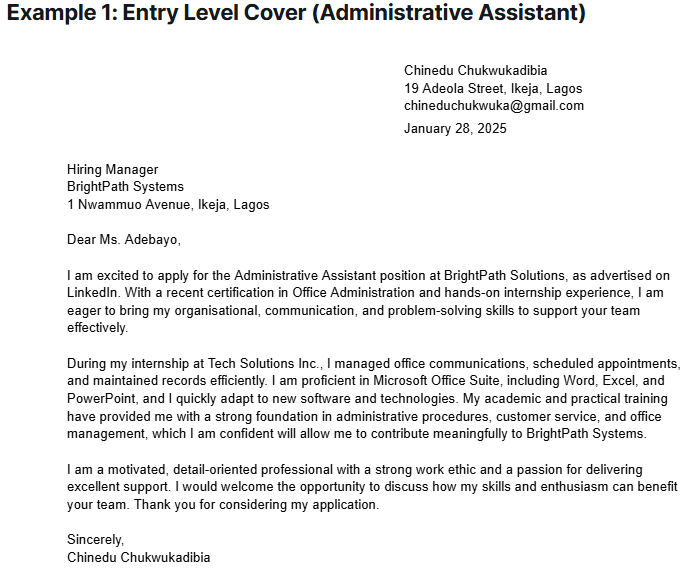
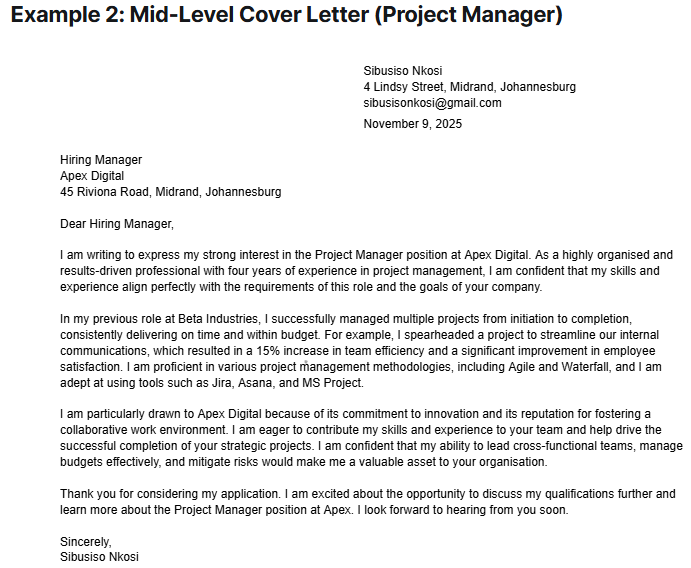
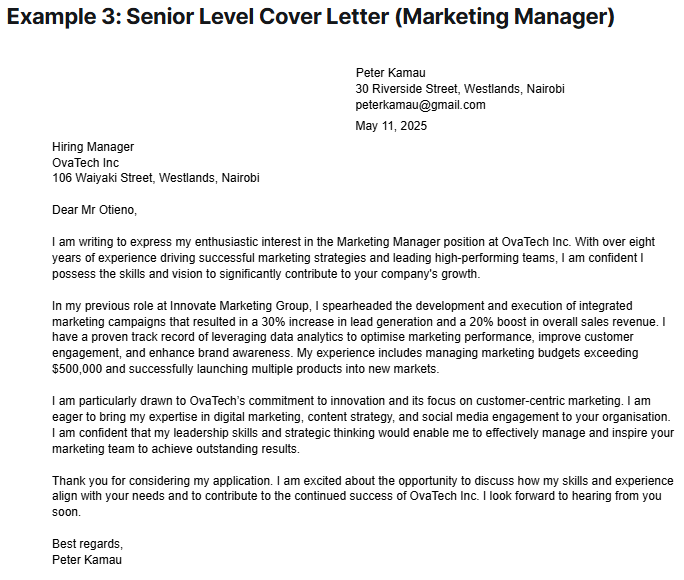
More cover letter examples here.
Conclusion
A strong application is rarely built around a single document. Instead, success often comes from presenting a consistent and professional picture across all materials. A carefully prepared cover letter for job application can play an important role in achieving that objective.
RELATED: Can ATS Read Cover Letters?